


Art Exhibition Online (Mr. Wenjiang Yu) NO.5
 |
ART EXHIBITION
|
powrót do listy >
|
ART EXHIBITION
|
powrót do listy >
Exhibition of Works by Chinese Figure Painter Yu Wenjiang |
First of all we thank Mr. Yu Wenjiang for his trust, support and authorisation for our foundation. It is forbidden to reproduce and use the photos of the works by anyone without the consent of the Foundation. In the event of a breach of rights, we will file a complaint for the protection of copyrights.
The memory of suffering pierces the soul |
Reading Yu Wenjiang's painting entitled Blood and pain - the Suffering of Chinese Women During the Sino-Japanese War |
Yu Yang |
Professor of the Central Academy of Fine Arts, Director of the Chinese Painting Research Section, Deputy Director of the National Research Centre for Thematic Art Creation |
In the twentieth century, one of the main problems faced by contemporary artists creating claborate-style figure painting was how to convey in historical themes people full of historical significance and patriotic feelings using traditional methods of modelling figures and classical painting techniques. China especially needed audacity and response in the form of artistic creation after the First Opium War in 1940, when the country had plunged into a semi-colonial and semi-feudal system. A look at modern and contemporary Chinese painting shows us the long, bumpy and pioneering path of historical art, as well as stylistically diverse research and attempts carried out by great artists using various means of expression. These artists created masterpieces that have gone down in the annals of history, such as Refugees by Jiang Zhaohe or Miner by Zhou Sicong. These are works conveying pain, full of tragedy and not devoid of the author's profound reflection on important historical events. All this became a new and important artistic issue.
Broadly speaking, in contemporary academic education two main avenues for the development of Chinese contemporary ink painting have emerged: one deals with traditional Chinese painting in terms of the “Jiang-Xu system”, and the other one follows the “new Zhe school”, in which figure painting is modernized by borrowing the artistic language from the styles of “scholar-painting” and “bird-and-flower painting”. Upon entry into the new century, with the popularization of art projects focused on national themes, and with the rise of the issue of appropriate presentation of the national perspective and historical depth of Chinese culture, numerous works of high artistic level have appeared in contemporary Chinese painting. As a leading representative of contemporary claborate-style painting, Yu Wenjiang, relying on a holistic view and depiction of history, using an original technique and language of representation, created masterpieces that have made a significant impact on the history of art.
For a time it was considered that, compared to Western realistic oil painting of the Renaissance period, rendering realistic themes was a weakness in the traditional methods of ink painting. Artists very rarely undertook a realistic representation of suffering, both in the mainstream court painting, as well as in "scholar-painting" or in folk painting. On the other hand, among the masterpieces of Western oil painting, there are many works dealing with the issues of suffering, misfortune and war, such as the
The Raft of the Medusa by Géricault, The Chios Massacre by Delacroix or Picasso's Guernica. These paintings recreate historical scenes in reflection on the spirit of the era. So to what power of expression and depth of analysis can traditional Chinese painting come to become the centre of interest for Chinese artists and theorists?
Yu Wenjiang studied at the Faculty of Fine Arts of Shandong Pedagogical University, then continued his studies at the Central Academy of Fine Arts and currently works at the Chinese National Academy of Painting. He combined and transformed the language of academic painting with his own creativity and research in the field of education, offering contemporary Chinese figure painting a whole set of methodologies and views in the field of realistic historical art. In 2009, after three years of work, his large-scale, ink-painted figure painting entitled Blood and Pain - the Suffering of Chinese Women During the Sino-Japanese War was completed. This work was displayed at the National Exhibition of Works Related to Historical Themes and is now in the collection of the National Museum of China. The painting proves Yu Wenjiang's deep understanding of thematic and historical creation, and also shows the possibilities of ink painting in the field of presenting historical depth and strength of spirit. For artists, the interpretation and reconstruction of history is a great and difficult challenge, because not only do they require master control over the depicted story and over the presentation of individual figures, but they also force them to repeatedly analyse the delicate relationships between the narrative and pictoriality. Yu Wenjiang entered this theme by showing female characters, in which he is an absolute master. He combined a historical event with a group of characters who became a symbol of the oppression of the nation - Chinese “comfort women”[1] from the time of war with Japan. Thus, by focusing the perspective on a group of female characters, Yu revealed a shocking historical tragedy.
When it comes to means of expression, Yu Wenjiang used the methods of composition and using light developed in the Jiang-Xu system, as well as abstract way of looking and striving to create the impression of existence of a single block, like in Zhou Sicong’s Miner. Even though Yu used flat composition to organize the space in the painting, his work is different from Jiang Zhaohe's Refugees. Refugees reflect Jiang Zhaohe's tragic personal experiences using a realistic technique; many figures in the painting were modelled on the artist's friends and neighbours, making up a work of art of exceptional realism. Blood and Pain - the Suffering of Chinese Women During the Sino-Japanese War by Yu Wenjiang, on the other hand, goes back to difficult events from several decades ago, and for this reason the creative process imperceptibly becomes much more difficult - there is the issue of conveying the suffering of that time through the language of art in the space of historical imagination. Yu Wenjiang, in order to depict this tragic episode of history with the enormous force released by the painter's brush, must carefully consider and develop elements such as figures creation, scene layout and tempo control.
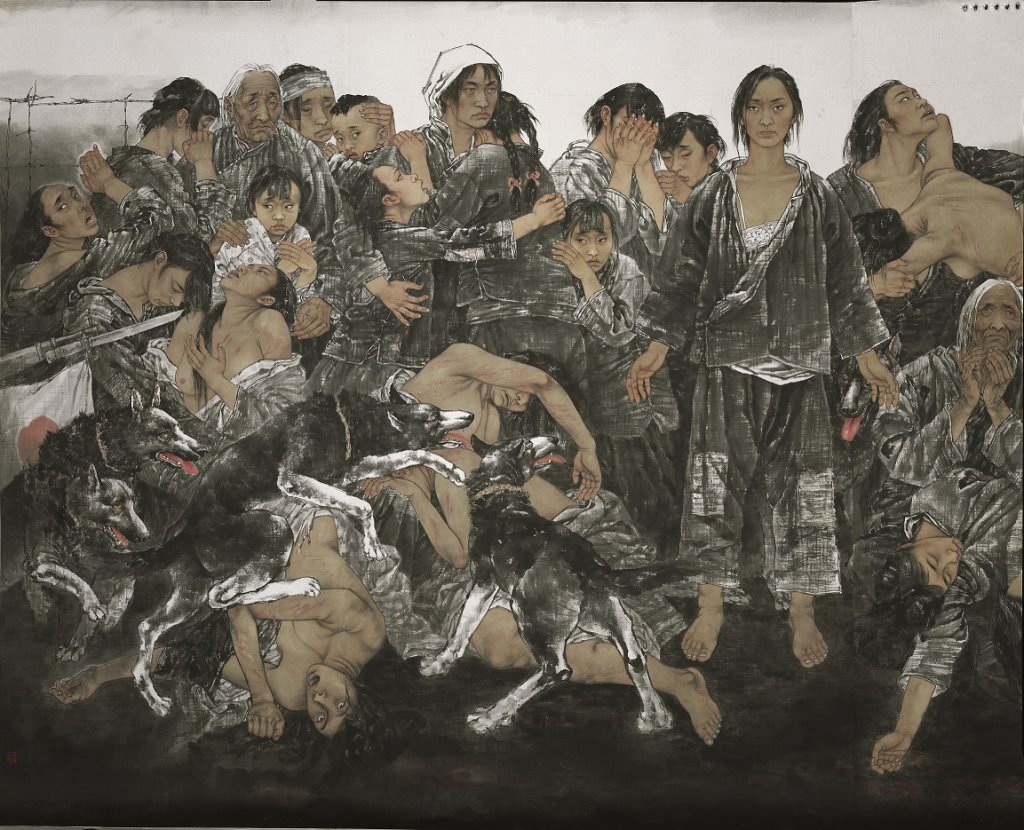
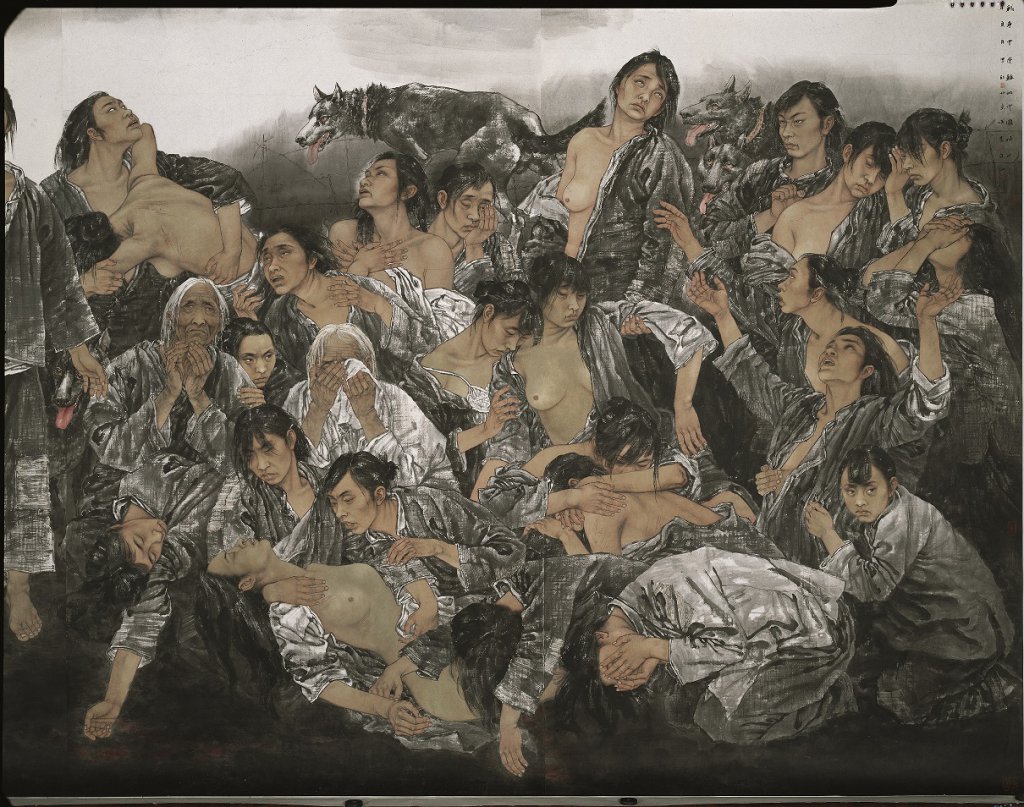
Looking carefully at Yu Wenjiang's Blood and Pain, we can see his skill and originality in composition and drawing. For example, elements such as the main character in the middle of the composition, standing in front of the viewer, the old woman praying next to her, both full of suffering beside other women as well as the razor-sharp bayonet on the left side and the dogs surrounding the scene show that the artist was not afraid of the en face depiction of characters, but decided to use the method of "writing lightly about important matters". In this way, the painter not only showed the allegorical and symbolic possibilities of ink painting, but also took advantage of the hierarchical layout and gradation of tension in groups of figures present in Renaissance art, thus creating a painting composition with a clear tempo and an impression of narrative. The further background of the painting is filled with a fog of ink which shows the landscape of the city oppressed by the black clouds of war and shows the poor social situation in times of defeat. The reason why the painting moves the viewer so profoundly is that Yu Wenjiang has shown with great force and accuracy the oppression and wickedness that Chinese women have struggled through. The excruciating sight of their trampled dignity radiates the awareness of the immense tragedy of the destroyed beauty, which, together with the precise depiction of the figures and realistic technique, makes the whole picture strike the viewer with its power and piercing nature.
In conclusion, both in Blood and Pain and other historical works, as well as in figure works on urban topics, Yu Wenjiang always focuses his perspective on female characters, incorporating his thoughts and deep concern about topics such as gender, nation, history and human nature. Chinese claborate-style figure painting urgently needs such masterpieces, masterpieces that are strong and full of life, but also masterpieces that are sensitive, especially in the context of contemporary artistic creativity, which is required "to have heights and high peaks." Such works will make Chinese and foreign audiences able to understand and empathize with the issues raised.
For this reason, thematic-historical art should be placed in a wider international and temporal context - for criticism and detailed research. While, Yu Wenjiang is undoubtedly a pioneer who, starting from the language of Chinese figure painting, puts all his energy into expressing the historical narrative. Yu not only showed the awareness and understanding of artists for cultural activities in a society full of historical transformations, but also interprets national interests and patriotic feelings from a personal perspective. There is a large group of young and middle-aged artists who constantly pursue artistic searches in the field of historical creativity. Many of Yu Wenjiang's works have already seen the light of day, and I believe that thanks to his original language of expression, his wisdom, talent and experience, he will be able to accelerate the development of Chinese thematic painting, thus making Chinese claborate-style figure painting find its place in the international artistic scene more confidently, faster and more often.
[1] A euphemistic term for women forced into prostitution by the Japanese during the Second World War
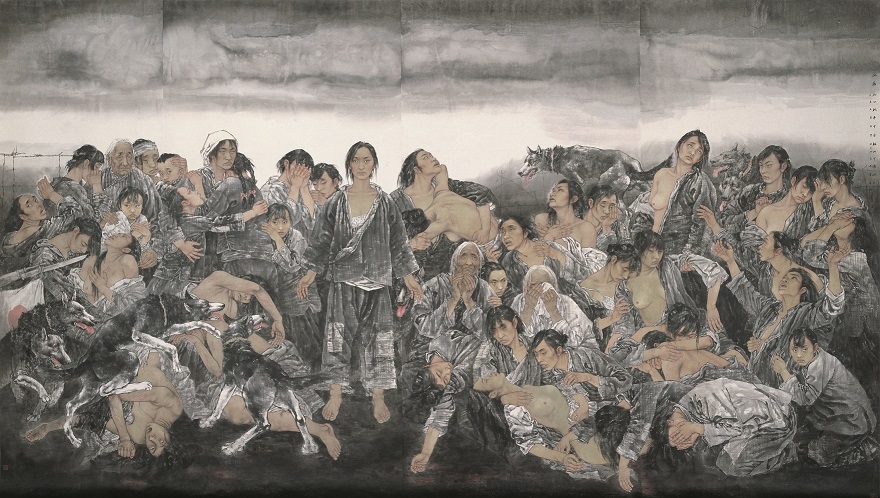
350cm×500cm
Komentarze do wpisu (0)